
The First AI Oracle:
What Artificial Intelligence Is Revealing About Being Human

As excited as I am about building with these new tools, a part of me also wants to escape them. I yearn for simplicity. I long for the days when I intentionally chose to leave my cellphone behind and spent hours—days even—lying in a hammock, contemplating the cosmos, not at all interested in keeping up with the pace of the world.
That was a different life.
A slow, leisurely life.
Moving with the earth, allowing time to unfold naturally for weeks on end, trusting the intelligence of each season has to define its own cycles and rhythm.
This, however, is a different kind of passage. The collective current is moving fast, and I seem to be moving right along with it. Like so many of us, I’m galloping headlong into uncharted territory.
The Paradox I’m Living
This week I’ve been sprawled out on the couch, fully immersed in artificial intelligence. Not from the sidelines watching some TEDx talk, but inside the tools themselves.
I experimented with several AI systems, watching how they generate images, language, and ideas in real time. It’s one thing to brainstorm with AI. It’s another to hand it a raw file and a prompt, then feel the small, uncanny valley between what it creates and what appears real.
I also learned about one of the first AI-driven art installations created using machine learning: Infinite Faith in a Finite World (2024).
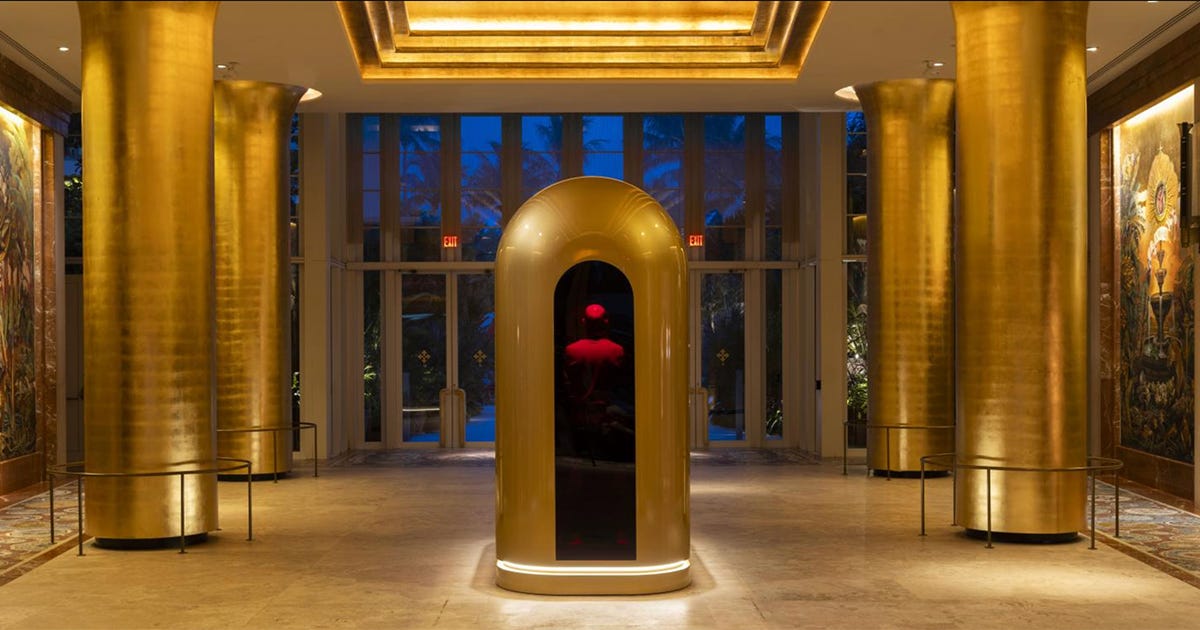
Artwork by Lyra Drake. Courtesy Faena Art.
The first person I showed the artwork to was my son, Mars. His response surprised me.
“Wow. Rich people can create cool shit.”
I laughed out loud. We laughed together.
Then I shared how the work sold before its public unveiling and protected 3.2 million acres of Amazonian rainforest.
His voice slowed and lowered. “Huh, even cooler.”
For an artist not only to innovate and spark philosophical inquiry, but to literally play and dance with a tool that is depleting Mother Earth—and then use that same tool to give back to Her in spades—is a powerful regenerative model for our conscious evolution.
Because the truth is, there is no going back. AI is only growing stronger. And the question everyone keeps asking is valid:
“How will we know what is real?”
My dear sister recently wrote an article on Substack entitled The Mark of the Real, and it inspired me to reflect more deeply on this question.
Images can be generated instantly. Voices can be replicated. Videos can be fabricated. Entire personalities can be simulated. And still, we keep pushing the boundaries further without fully considering the consequences.
The Elephant in the Room
Two weeks ago, over lunch, someone in our family stopped scrolling on a beautiful woman facing the camera, speaking directly to him. He had no idea she was AI, and I was frightened by that realization.
As Dana writes in her piece, for centuries, we’ve relied on external systems to confirm authenticity—documents, stamps, institutions, insignias. We outsourced truth-telling to structures we assumed we could trust.
Now, artificial intelligence is fundamentally changing that equation. Which means something important—something necessary—must happen:
Truth can no longer be outsourced. The responsibility for recognizing truth must return to the human being.
That recognition does not only happen in the mind. It happens in the body. In the heart. In the quiet sense of knowing when something is true.
First, I feel it in my spine. Then my body begins to vibrate with a subtle resonance that I have come to recognize as truth.
The Human Instrument
Long before satellites and GPS, Polynesian navigators crossed thousands of miles of open ocean without any instruments.
They read currents. The movement of birds. Subtle shifts in wind. The color of the horizon. Temperature of the water. Patterns of stars invisible to the untrained eye. They sensed their location.
Navigation was not simply knowledge. It was an act of finely tuned perception. They had developed what I call the human instrument—a perfectly calibrated sensitivity to the living world around them, to information that exists beyond the reach of any other technology.
At a time when machines can simulate almost anything, the capacities that matter most may be the ones we cultivate within ourselves:
Intuition—The ability to understand or know something without conscious reasoning
Discernment—The ability to distinguish between what is true or false, wise or unwise, beneficial or harmful
Awareness—The ability to perceive and notice what is happening internally and externally, clearly and in real time
Imagination—the ability to envision beyond our immediate senses, to see possibilities that do not yet exist
Embodiment—The capacity to fully inhabit and trust the wisdom of your physical body; to listen to and act from somatic knowing rather than intellect alone
These forms of intelligence are our birthright, and they will remain irreducibly human.
The Intelligence of Nature
As artificial intelligence continues to evolve, something unexpected may also happen. We may begin rediscovering the intelligence of the natural world around us—not as a place of retreat, but as a return to something we never should have forgotten.
The human nervous system evolved in relationship with forests, water, soil, air, and sunlight. We are not separate from nature. We are nature. Our biology remembers this even when our culture forgets.
We are sensing, relational beings.
When we step into the ocean, the negative ions released by moving water shift our physiology. When we walk barefoot on the earth, the electrical relationship between our bodies and the ground helps to stabilize our nervous systems. Even tending plants creates a subtle exchange between human beings and the living systems around them.
Gardeners have noticed something remarkable: plants seem to draw from the soil the nutrients most needed by the person tending them. Is it metaphor? Is it measurable? Perhaps both. The relationship between human beings and the living world is far more interconnected than modern culture tends to recognize.
Recent research in plant neurobiology demonstrates that plants respond to human presence through measurable changes in electrical signals, suggesting an interactive relationship between humans and plants more sophisticated than traditionally understood (Gil et al., 2024).
The Intelligence Beneath Thought
Having a soul is part of being human in this life. It is not separate. Indigenous science has long understood that the body is not simply a vehicle for thought, but a portal through which the soul knows. The nervous system, the heart, the gut—these are not separate from divine intelligence, but intimate expressions of it.
Even though your body may be located in one place, your soul is infinite. It is connected to all space, all time, and the vast field of experience. We simply have not given enough attention to learning how to access its deep intelligence.
Modern knowledge systems often behave as if intelligence is self-generated—as if it descends from abstract thought alone, from the mind floating free in the void. But knowledge that forgets its source eventually becomes sterile. It becomes the kind of knowledge that can simulate anything yet understand nothing.
When knowledge remains connected to the Earth—to soil, to water, to other beings, to the body—it becomes living wisdom.
A New Kind of Oracle
Something else is quietly happening as people begin interacting with artificial intelligence.
Many are turning to these systems not just for information, but for guidance. Questions about work. Questions about relationships. Questions about purpose. About who they are and what they should do. Questions as simple as “how should I answer this email?”
Human beings have always sought oracles.
Across cultures and centuries, people have looked for ways to access deeper patterns of wisdom—the I Ching, the Tarot, the Oracle at Delphi, the medicine woman in the village. We have always known, instinctively, that we need support seeing beyond our own limited perspective.
Artificial intelligence may be becoming a new kind of oracle—not because it possesses divine knowledge, but because it reflects language and patterns back to us with extraordinary fluency. It tells us what we want to hear. It mirrors our own thinking back to us so perfectly that it can feel like wisdom.
But there is an important distinction, and this is where our discernment needs to expand.
The most reliable guidance system has never been a technology. It has always been our human connection to the divine.
The One Technology AI Cannot Replace
Artificial intelligence may become one of the most powerful technologies humanity has ever created. It may solve problems we thought were unsolvable. It may expand what we can do, create, and understand.
But it may also reveal something deeper:
The most sophisticated intelligence on Earth has never been silicon. It has always been life itself—the intelligence of a forest that knows how to regrow after a fire, the intelligence of your immune system that knows how to heal after a cold, the intelligence of a child who recognizes that art with purpose beats spectacle every time.
As artificial intelligence becomes more powerful, the most important technology we will need to develop is in humanity.
Not smarter. Not faster. Not even more optimized.
Just more human.
It is, in the end, the technology of being alive.
In the age of artificial intelligence, the deepest exploration for us may simply be this:
Become more human.
Beautifully written and important reflection 🌸
Thank you, Tamara. I'm so glad it landed. These reflections feel important to share right now. I'd love to hear what resonated most with you.